At Glance
On Sunday 13 September 2026, Manchester City beat Manchester United 1–0 through a goal that Pro Ref admitted should not have stood. The offside technology correctly established that Erling Haaland was onside. The VAR officials then failed to recognise the possible impact of Enzo Fernández and did not recommend an on-field review. The error was admitted within hours. The result cannot be changed.
1. What Happened
The goal came in the 60th minute. Joško Gvardiol crossed, the ball took a deflection off United defender Patrick Dorgu, and Haaland turned it in at the back post. The assistant referee flagged, and the goal was disallowed on the field for offside against Haaland.
Semi-automated offside technology showed that Dorgu’s outstretched foot had kept Haaland onside when Gvardiol played the cross. That part of the review was accurate.
But Haaland was not the only player whose position mattered. Fernández was closer to goal, in an offside position, and lunged at the ball immediately in front of Lisandro Martínez without touching it.
Under IFAB Law 11, a player does not have to touch the ball to interfere with an opponent. In plain English, an offside player may commit an offence by blocking an opponent’s view, challenging for the ball, trying to play a nearby ball in a way that affects an opponent, or making an obvious action that affects the opponent’s ability to play it. Fernández’s movement therefore required a judgement about its impact on Martínez.
During the match, the Premier League Match Centre said the goal stood because Fernández had not touched the ball. Pro Ref went further that evening. It said the VAR had established that Fernández did not play the ball but “did not recognise the likely impact of his position and should have recommended an on-field review”.
That distinction matters. The technology decided only whether Haaland was onside. The VAR then had to judge whether Fernández had interfered with Martínez. Pro Ref’s account is that the VAR got that judgement wrong and should have sent the referee to the monitor.
We do not yet know whether the referee or assistant referee saw Fernández’s action clearly or considered it when the goal was first disallowed. We do know that the referee was not subsequently shown it at the monitor, because the VAR did not recommend the review.
The apology went to Manchester United. The three points stayed with Manchester City. The following day Pro Ref stood down VAR Matt Donohue and assistant VAR Blake Antrobus from the next round of fixtures.
The offside technology did not fail. The VAR decision process did.
2. Where the Decision Failed
Calling this simply a “VAR failure” hides an important distinction. VAR includes both technology and people. Here the technology supplied accurate positional evidence. The error occurred when a human official applied the offside law to the wider incident.
Pro Ref said the VAR officials should have recommended an on-field review, allowing the referee to decide whether Fernández had interfered with Martínez. That was part of the decision process, not a remedy when the process failed. Once the check was completed and play restarted, there was no further in-match review and neither team could challenge the decision.
This is where the governance issue begins. The immediate error may have been an individual one, and Pro Ref has acted against the officials on that basis. But the investigation must also ask whether the protocol, training, communications and checks around the VAR made the complete task clear: establish the relevant positions, identify every possible offence and ensure that any subjective judgement is made by the referee.
It must also examine how the technology, VAR, referee and assistant referee interacted. Who saw what? What was communicated? What did the check cover? Why did the absence of a touch become the apparent reason for awarding the goal when the law does not require contact? Until the review is complete, those questions remain open.
In The Point Where Judgement Moves, we argued that technology changes where decisions are formed. That is visible here. The referee formally retained the final authority, but the VAR’s failure to recommend a review meant that the referee never saw the incident again and never made the decisive subjective judgement. The decision was effectively settled before it reached him.
That is the wider lesson. Accurate technology can strengthen confidence in one part of a decision and, at the same time, distract attention from another part that still depends on human judgement. The organisation must govern both.
3. Testing the Framework
Beyond the Algorithm: When Accuracy is Not Enough separates two questions in any technology-assisted decision: what happened, and what the rules should make of it. The technology answered the first question about Haaland’s position. The VAR then answered the second question about Fernández’s impact incorrectly.
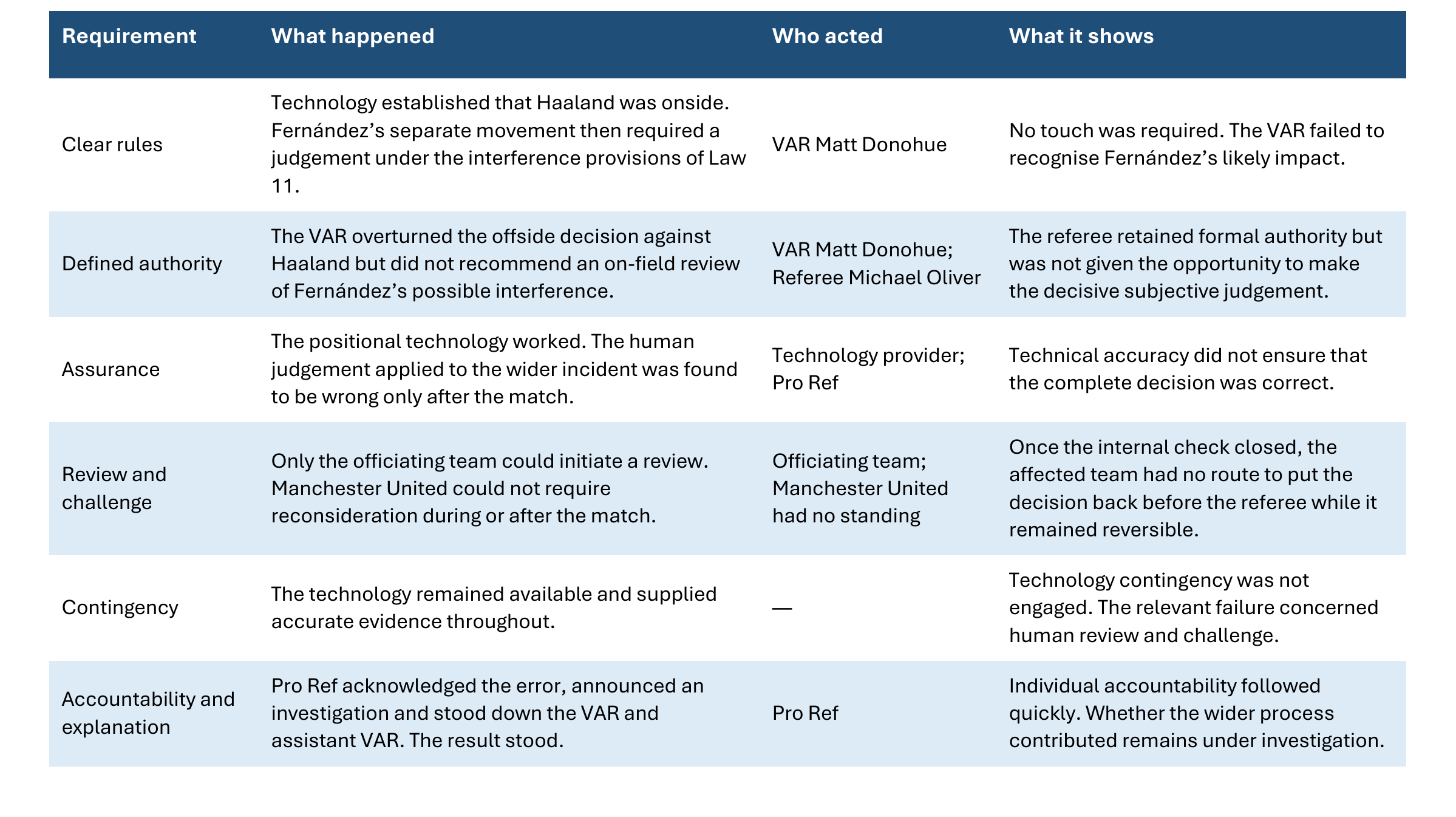
The six requirements in the framework show where football’s arrangements worked, where they did not, and which requirement was not relevant to this incident.
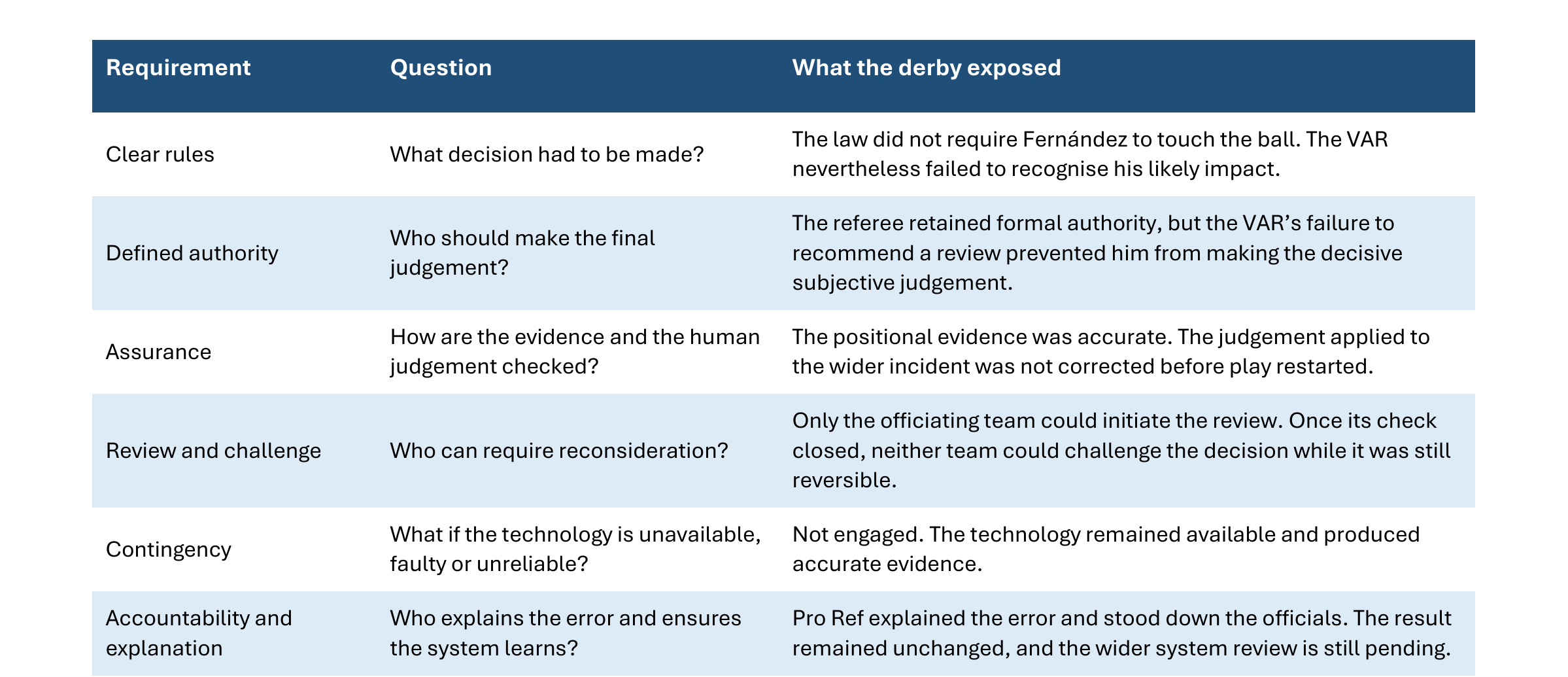
The pattern is not that every part of football’s framework failed. The technology worked, and the authority of the referee was formally clear. The failure arose in the connections between the parts: the evidence produced by the technology, the VAR’s interpretation, the referee’s opportunity to decide, and the teams’ ability to challenge the outcome.
4. Remedy, Standing and Legitimacy
Football had a route for correcting the judgement: an on-field review. But only the VAR could initiate it. When this was not done by either the technology or the official, nobody else—the referee, the assistant referee or either team—required the incident to be reconsidered before play restarted.
Cricket gives each team a limited number of referrals during play. Football does not. Its review process remains wholly inside the officiating team. That difference matters because the party carrying the consequence has no standing in the process.
After the match, Pro Ref used the only instruments still available: explanation, apology, investigation and discipline. None could restore the point—or potentially three points—lost by Manchester United.
A review mechanism is only a remedy if it can be used while the decision remains reversible. Once the final whistle has gone, an apology explains the failure; it does not correct it.
That is also why this incident affects legitimacy. In Power, Legitimacy and the Illusion of Control in Sport, we argued that institutions are judged not only by whether they reach the right answer, but by whether people believe the answer was reached through a legitimate process. Here responsibility was placed rapidly on two officials, while the consequence remained with Manchester United and the League.
Lisandro Martínez’s response went beyond disagreement with one decision: “Every season they come to our club, they explain the rules for an hour and a half, and they look so confident. And then you have five or six people making this mistake.” That is a challenge to confidence in the process itself.
5. What This Means for the Event or League Owner
This is not solely an issue for referees. Three institutions hold different parts of the decision system.
1. IFAB owns the Laws of the Game and must ensure that the rules remain workable when technology reveals positions and movements that officials could not previously detect with the same precision.
2. Pro Ref supplies, trains and assures the match officials. It must establish why the relevant impact was not recognised, whether the protocol and decision process were clear, and how the referee and VAR should interact when objective evidence leads to a subjective judgement.
3. The Premier League owns the competition. It must decide whether review should remain entirely within the officiating team, what information should be disclosed, and whether a limited right of challenge should be developed and proposed for trial.
The league does not have to wait passively for IFAB to rewrite the law. It can examine the operation of its own competition, develop a challenge model, seek approval to trial it and require clearer evidence that the entire incident—not only the technology’s output—has been reviewed.
Any Event or League Owner using technology for consequential decisions must govern the whole chain: what the technology establishes, what remains a human judgement, who must make that judgement, how the different people and systems interact, and who can intervene before the decision becomes irreversible.
Conclusion: Accuracy Was Not Enough
The technology answered accurately. The VAR made the wrong judgement. The referee was not given the opportunity to review the subjective issue, and neither team had any right to challenge the decision before it became final.
The immediate failure belonged to the VAR process. The governance task now belongs to Pro Ref and the Premier League: determine why the impact was missed, test whether the protocol, training and communications contributed, and decide whether a decision of this consequence should depend entirely on the same officiating team recognising and correcting its own error.
That is the wider lesson for any organisation using AI, automation or technology-assisted evidence. Accuracy in one part of the system does not guarantee a sound decision. The rules, people, authority, checks and routes of challenge around the technology matter just as much.
Pro Ref’s investigation may add to or alter the factual account above. It will not change the central point: technology can improve the evidence, but the organisation remains responsible for the decision.
Source Links
Premier League Match Centre — official match explanation
Pro Ref statement acknowledging the error — Reuters
Confirmation that Matt Donohue and Blake Antrobus were stood down — Reuters
Ordo Papers Applied in This Case Study
Where the judgement sat
The Point Where Judgement Moves: Why AI Governance Now Matters More Than Technology in Football
The framework tested
Beyond the Algorithm: When Accuracy is Not Enough
Responsibility personalised, consequence collective
Power, Legitimacy and the Illusion of Control in Sport
Consequence carried by another party
The Event Succeeds. The Host Pays.; The Hidden Fragility in Modern Sport
Annexe A — Worked Example
Manchester United v Manchester City, Premier League, Old Trafford, Sunday 13 September 2026. The six requirements applied to the incident: what happened, who acted and what the evidence currently shows.